1st Edition
An 'Edition 1' stamp sits on the left edge below the artwork. It is the rarest and most sought-after version of the set.
The 1999 Base Set is where the value gap between a raw card and a high-grade slab is the widest in all of TCG. It is also where disappointment is most common: Wizards of the Coast print runs are notorious for loose cutting.
A Pokémon Base Set card (Wizards of the Coast, 1999) is graded on the usual four criteria, but centering is by far the limiting factor: the print sheets of that era were poorly calibrated, and a significant share of copies exceed 60/40 on the front, which caps them at 8 with PSA. Before submitting, identify the version first — 1st Edition (stamp to the left of the artwork), Shadowless (no drop shadow to the right of the frame), or Unlimited — because it completely changes the value, and therefore whether the submission pays for itself.
01 — Cards
The four pieces that carry the 1999 edition's value.
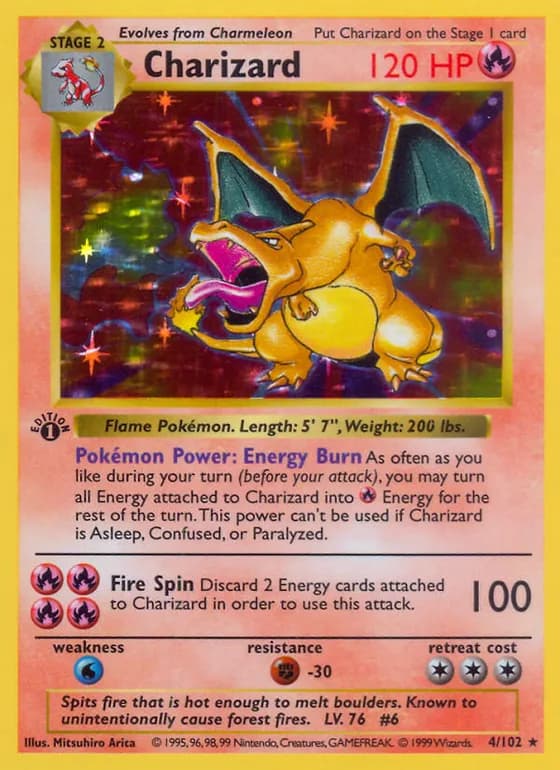
Charizard
4/102 · Holo Rare
The set's benchmark card
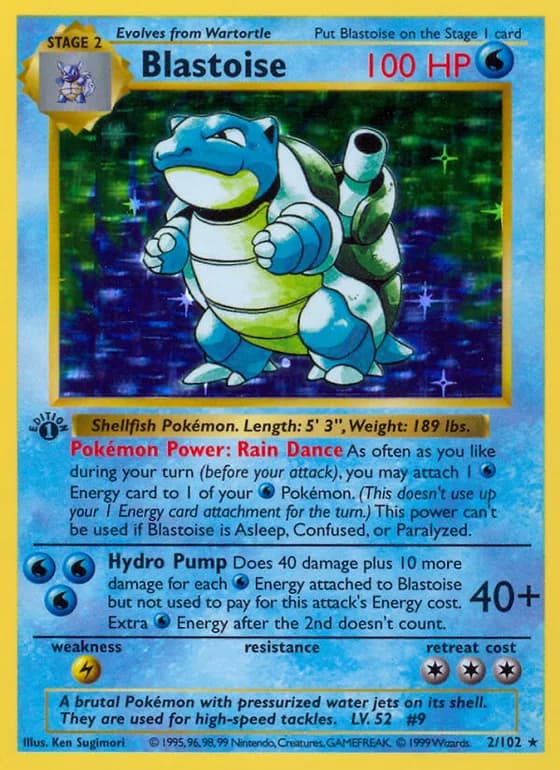
Blastoise
2/102 · Holo Rare
Often poorly centred

Venusaur
15/102 · Holo Rare
Light background shows marks
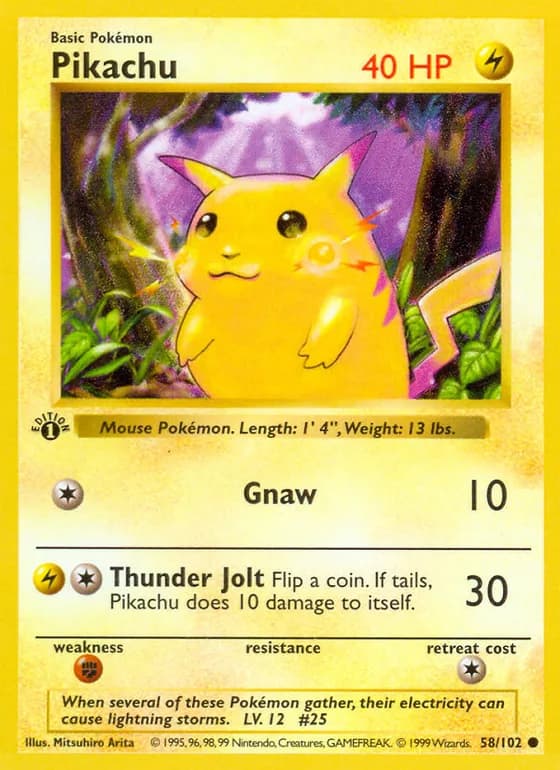
Pikachu
58/102 · Common
Cheap raw, heavily graded
02 — Key facts
03 — Key points
In the order they cost you points.
1999 cuts are irregular. Measure the left/right margins of the yellow border: above 60/40 the 9 closes, and past 65/35 the 8 goes too, however good the card is otherwise.
The holo layer on the sixteen shiny cards scratches from simple rubbing in a binder. It only shows under raking light — tilt the card before concluding it is clean.
The plain blue back forgives nothing: a slightly whitened corner or edge jumps out. It is often the back, not the front, that turns a 10 into a 9.
Shadowless and Unlimited look alike at a glance. Getting the version wrong means being off by a factor of 3 to 10 on value — and submitting a card that will never cover its fees.
04 — Details
An 'Edition 1' stamp sits on the left edge below the artwork. It is the rarest and most sought-after version of the set.
No stamp, but no drop shadow along the right edge of the artwork frame, and a thinner HP font. An intermediate print run, considerably rarer than Unlimited.
A clear drop shadow to the right of the artwork frame. This is the mass print run: grading only makes sense on iconic cards in excellent condition.
05 — Questions
Rarely, and not because of wear. Off-centering is created at print: a card untouched since 1999 can be 70/30 off-center and cap at 7. That is exactly why screening pays so well on this segment.
Only iconic cards in excellent condition. On a common Unlimited, the grading fee far exceeds the card's value, even at a 10.
PSA for liquidity: it is the slab vintage Pokémon buyers know and look for, and at equal grade it sells faster. CGC is appreciated for its slab. From Europe, PCA avoids transatlantic shipping costs and customs delays on mid-value cards.
Two photos are enough to know whether your copy sits in 9 or 8 territory.